
Types of Water Filters
Finding the right water filter is important. Years ago there wasn’t as many options as we do today. Here is some personal research I did on the types of water filters.
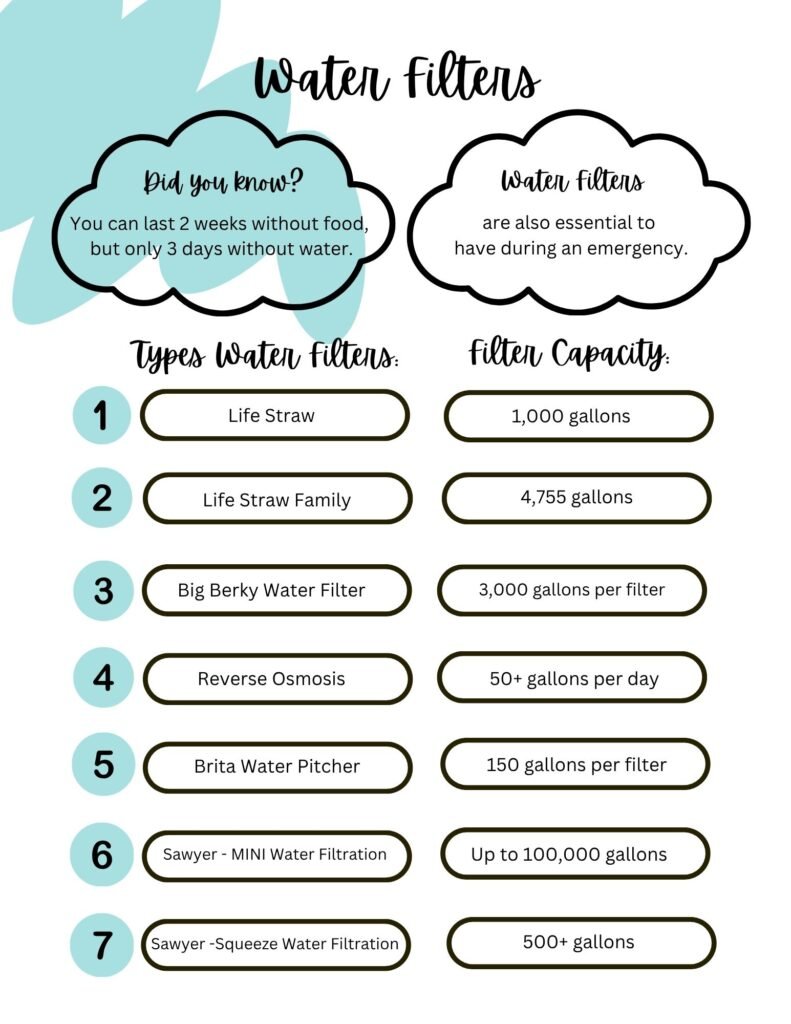
So which water filter should I purchase?
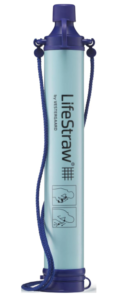
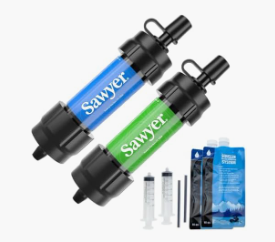
Both of these water filter straws are great to have, but let’s break it down to size, filtration, portability, price, and function to figure out which one is a better fit for you and your family.
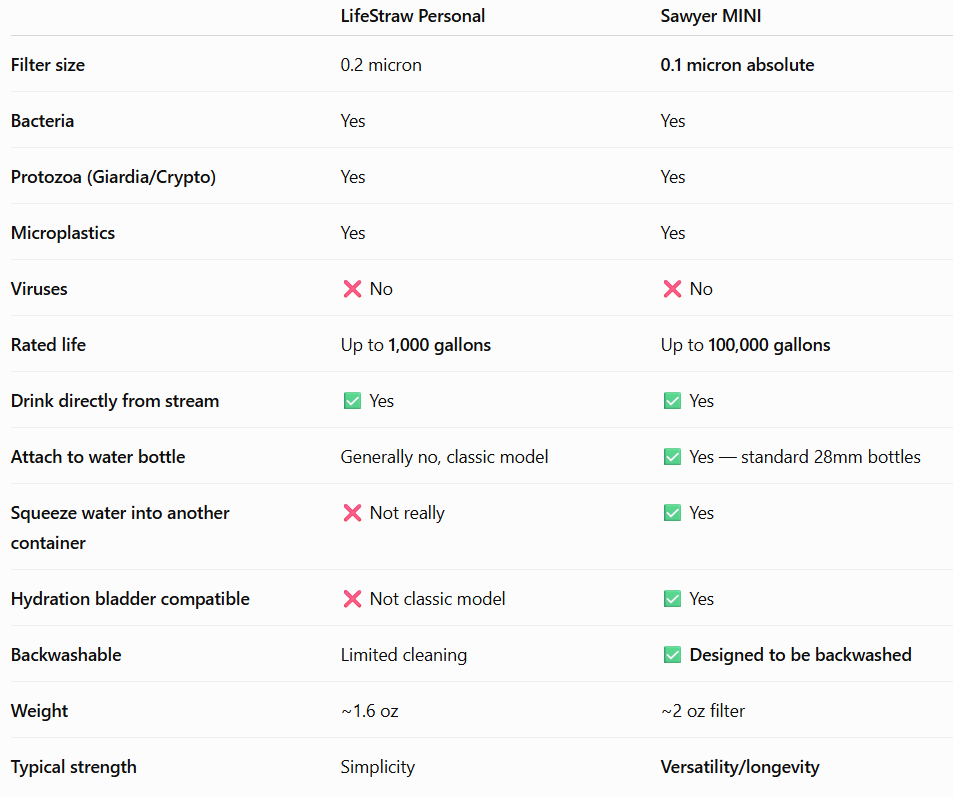
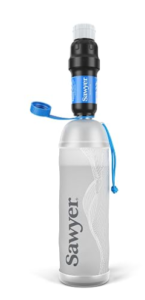
The biggest difference for preparedness is that the Sawyer is more of a water filtration system, whereas the classic LifeStraw is primarily a drink-through straw. With the LifeStraw, you basically get down to the water source and suck water through it. With a Sawyer MINI, you can do that too, but you can also fill a pouch, screw the filter onto it and squeeze filtered water into cups, pots, bottles, etc. You can even screw it onto many ordinary disposable water bottles. As a mom with young kids, a Sawyer straw is a no brainer!
One HUGE Sawyer advantage: lifespan
LifeStraw Personal: rated for up to 1,000 gallons.
Sawyer MINI: rated for up to 100,000 gallons, provided it’s properly maintained/backwashed.
That’s a 100× difference in the manufacturer’s rated capacity.
Technically, because you can squeeze water into another container, you could buy one Sawyer Squeeze for the entire family where as for the LifeStraw you would most likely need to buy for each individual member. That right there saves you $$$.
But there’s an important misconception about the 0.1 vs 0.2 micron numbers
Sawyer’s 0.1-micron absolute membrane is finer than LifeStraw’s 0.2-micron membrane. However, both are designed to remove the major biological threats you’d normally worry about in North American backcountry water—bacteria and protozoa such as Giardia and Cryptosporid.
If I were choosing one for an emergency kit…
I’d lean Sawyer, especially for a family.
LifeStraw’s advantage is basically: cheap, incredibly simple, lightweight, grab it and drink. But there have been complaints of it being hard to suck up water when drinking from the stream which can be downside, especially with littles.
Sawyer’s advantage is: much longer rated life, finer filtration, backwashable, bottle-compatible, pouch-compatible, hydration-system compatible, and capable of filtering water for someone besides the person holding the straw.
So for a 72-hour kit where you want a dead-simple backup, a LifeStraw makes plenty of sense. For long-term emergency preparedness, I’d rather have a Sawyer MINI—or, even better, the full-size Sawyer Squeeze, because Sawyer says the Squeeze has a faster flow rate and needs less frequent backwashing than the MINI.
But wait, there's more!
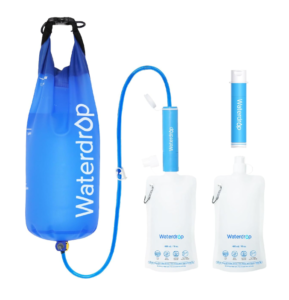
Waterdrop Gravity Water Filter Straw system is one of my favorite preparedness items I own.
How it works
You fill that big blue 1.5-gallon bag with untreated water, hang it from a tree, hook up the hose and filter, and gravity pushes the water through the filter. Clean water comes out the other end.
So instead of this: Creek → straw → your mouth
You can do: Creek → 1.5-gallon bag → filter → clean-water container
That’s MUCH more practical if you’re trying to provide drinking/cooking water for a family during an emergency.
And you aren’t locked into gravity mode. The filter itself can also be used as a traditional straw or connected to compatible bottles/pouches.
The Waterdrop also includes water filters which are just as good as the Sawyer straw, which is an added bonus.
VIDEO: WATCH HERE how I use my Gravity Waterdrop.
So let's compare...
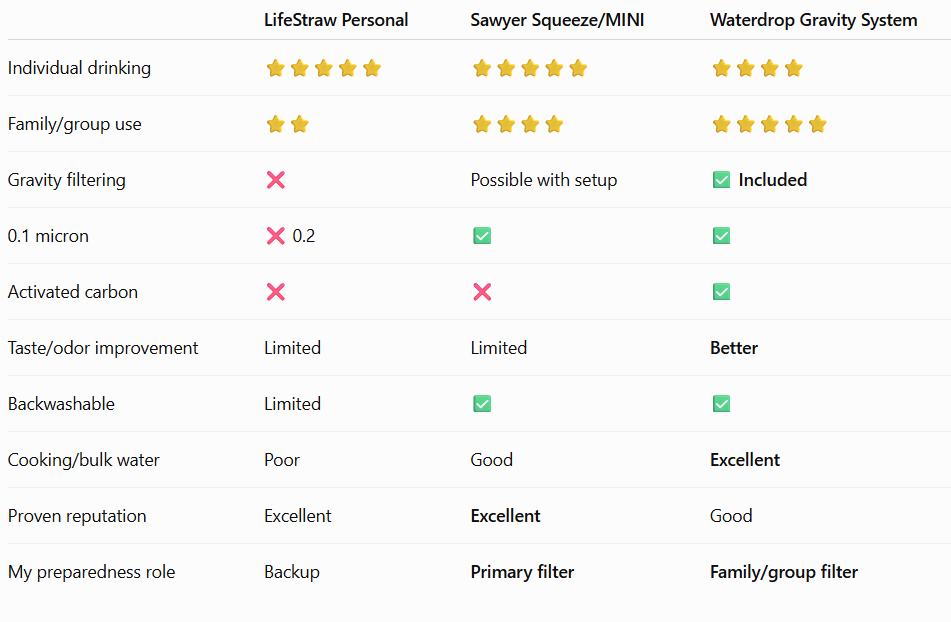
For a family emergency kit, this Waterdrop makes a lot of sense. The 1.5-gallon dirty-water reservoir is probably its biggest selling point—not the “straw.”
I’d probably still trust a Sawyer Squeeze as my primary backcountry filter because of Sawyer’s track record and simplicity. But for something that sits in a 72-hour kit, vehicle, cabin, or home emergency supplies and may need to provide water for several people, I really like the having the Waterdrop kit as an option.
And if I were putting together a serious family preparedness setup, I’d actually have both: a gravity system like this for bulk water and a Sawyer/LifeStraw-type filter in individual packs as backups.
Click Here to Shop Water Storage Products
Alright, but what about home water filters?
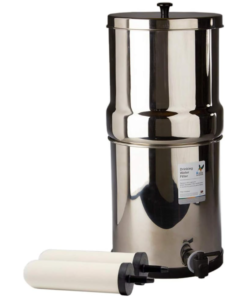
I wouldn’t obsess over the Berkey vs Purewell vs Waterdrop stainless container nearly as much as I would obsess over what filters are inside it.
For everyday drinking water plus emergency preparedness, my shortlist right now would probably be:
British Berkefeld/Doulton — strongest appeal to me because of the long track record and unusually clear third-party NSF certification for specific gravity-filter claims.
ProOne — extremely interesting if broad chemical reduction and fluoride removal are priorities.
Berkey — still a strong system and an enormous preparedness ecosystem, and the newer NSF-listed Phoenix configuration improves the certification story.
Purewell — probably the one I’d look at if budget/value is the priority. Their published testing is encouraging; I simply wouldn’t give their testing the same weight as a contaminant-reduction claim independently certified and listed by NSF.
And there is actually another category I’d put above all of these for certain situations: countertop/under-sink reverse osmosis. RO is much better at removing many dissolved contaminants that gravity carbon/ceramic filters struggle with—but it requires more infrastructure and is generally much worse as a grid-down preparedness solution.
So if your goal is “What should a family own to have safe drinking water both every day AND during a serious emergency?”, I think the ideal setup is actually a combination of stored water + a gravity filter + a true purification/disinfection method.